Organizational Knowledge Brain
Not another database — a second brain for your organization that remembers, connects, and reasons.
Graph-RAG
graph + agentic retrieval
Air-gapped
data never leaves the network
Self-improving
learns from real queries
Yesterday's tools can't keep up with today's flood of data. Logging and retrieving information in legacy systems is slow and laborious, keyword search is low-quality, and traditional systems don't actually understand content — they can't reach the knowledge hidden between text and non-text data, or the complex relationships that connect them. The result is reports, contracts, and records full of human error that never turn into insight.
The Organizational Knowledge Brain replaces the static file archive (KM 1.0) with a living, learning ecosystem (KM 2.0): a cognitive engine that remembers everything, extracts conceptual relationships, fuses multimodal data, and reasons in the moment like a domain expert.
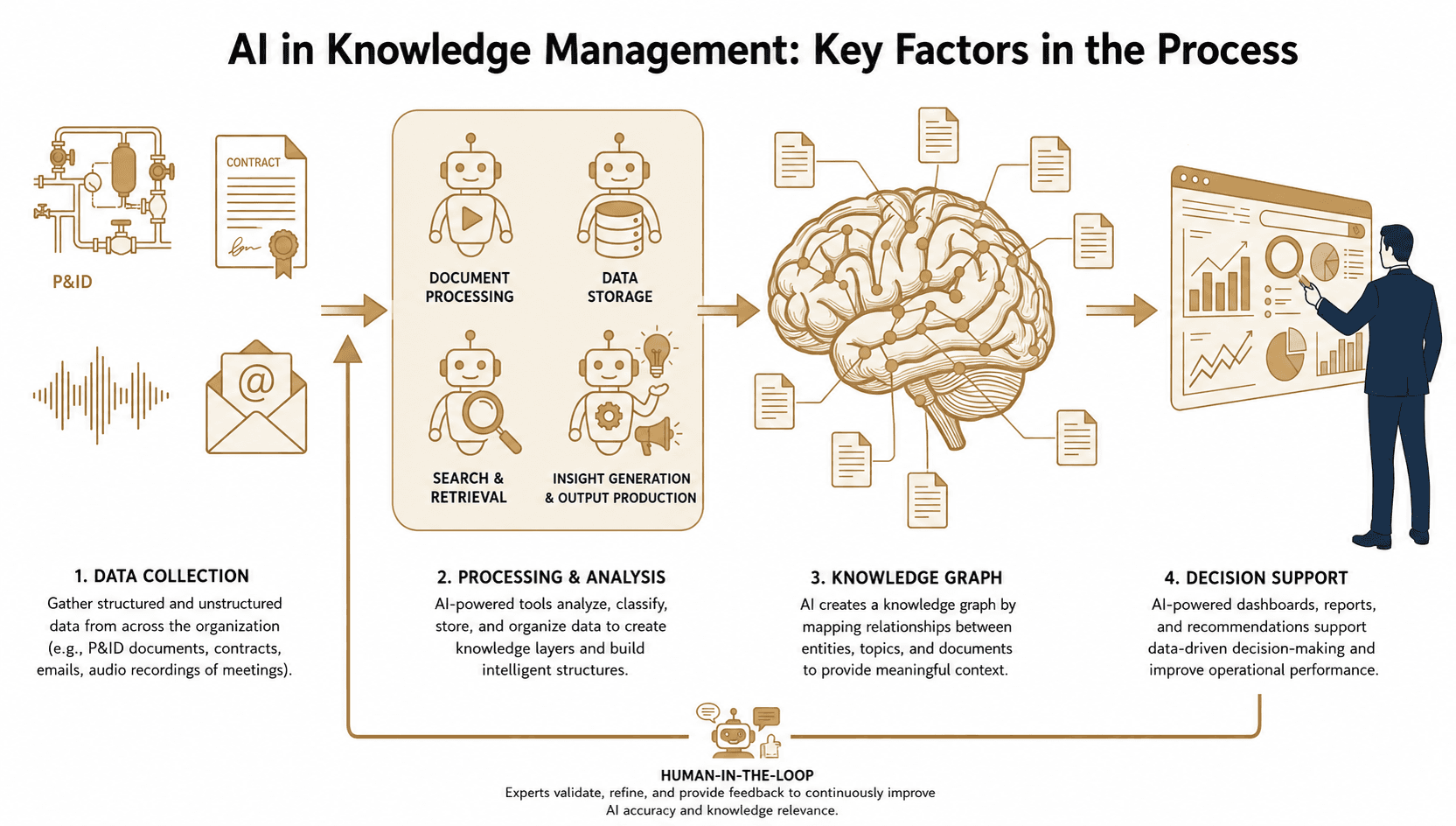
At its core, intelligent agents ingest and listen to every source — documents, contracts, emails, meeting audio — then analyze, classify, and enrich it; a unified knowledge graph surfaces the hidden relationships between data, equipment, and people; and the system produces accurate, cited answers, smart reports, and operational insight, with a feedback loop that keeps sharpening every result.
On that foundation sits a suite of expert assistants: a semantic-search organizational memory you can chat with, a meeting voice assistant that turns recordings into structured minutes, an agent-driven document and report generator, plus specialist assistants for legal and contracts, accounting and finance, supply chain, process safety and risk, and engineering-drawing digitization. A strategic layer adds tender and business-development support, negotiation, a knowledge-transfer “digital mentor,” intelligent résumé evaluation, and an employee personal assistant.
The platform is designed to improve itself and to stay secure by architecture. The knowledge graph is not static — it reshapes itself around the questions an organization actually asks, so over time its edges become the most efficient paths to an answer. A skill repository documents how experts work so the system grows more capable every month without code changes. And every deployment is security-by-design: paragraph-level role-based access control (RBAC) and fully air-gapped, on-prem operation mean no byte of sensitive data ever leaves the network.
What it does.
Cognitive knowledge graph (Graph-RAG)
Three layers working together: semantic retrieval that understands meaning instead of matching keywords, a knowledge graph that connects siloed systems (ERP, HR, CMMS) and maps the relationships between entities, and an agentic reasoning pipeline that chains multiple steps to reach complex analytical answers.
Conversational organizational memory
Chat with your documents and data instead of searching them. Multimodal retrieval understands tables, charts, and text inside PDFs, drawings, video, and audio, and uncovers hidden links between data, equipment, and people.
Meeting voice assistant
Turns meeting audio into structured minutes automatically: speaker diarization, extraction of decisions, action items, and risks, instant fact-checking against company data, and semantic search across the entire meeting archive.
Multi-agent orchestration
An orchestrator delegates to specialist agents — retriever, processor, store, and action/output agents, plus role agents like finance and legal — and runs parallel reviews so several experts can assess a single document at once.
Self-improving by design
The knowledge graph optimizes its own structure around real user queries, and a skill repository captures expert workflows so accuracy compounds over time — an advantage no competitor can ship on day one of install.
Expert assistants across functions
Legal and contract risk analysis, accounting and finance reporting, supply-chain forecasting, process safety and risk, engineering-drawing digitization, tenders, negotiation strategy, knowledge transfer, talent acquisition, and everyday employee support.
No-code automation
A visual, agent-driven canvas lets teams automate complex organizational processes — and personalize the platform to needs beyond the prebuilt modules — without writing any code.
Security & data sovereignty
Security-by-design with paragraph-level RBAC and fully air-gapped on-prem deployment. Critical information never leaves the internal network, and answers are grounded and cited rather than hallucinated.
Agents in service of knowledge
The end-to-end loop: intelligent agents ingest and read every source (documents, contracts, emails, meeting audio), process and enrich that data, build a unified knowledge graph to understand hidden conceptual relationships, and empower users with accurate answers, smart reports, and operational insight — all refined by a continuous feedback agent.
Explore other projects.
Ergonomic Risk Platform
Markerless ergonomic assessment from a single ordinary camera.
View detailsHSESmart HSE Site Monitoring
Turn the cameras you already have into a 24/7 safety officer.
View detailsHSESmart Kitchen Safety OS
From a yearly inspection snapshot to a kitchen that is continuously self-aware.
View detailsPrivacy & SecuritySensitive-Data Redactor
Find and redact sensitive data — while keeping records usable.
View detailsAI PlatformsConstruction Regulation Assistant
Context-aware technical consultation, grounded in the regulations.
View detailsAI PlatformsAutomotive After-Sales Intelligence
Four integrated AI modules that turn after-sales service into an accurate, self-improving system.
View detailsAI PlatformsIoT Smart-Metering Platform
Real-time monitoring and control over low-power, long-range networks.
View detailsTell us what you're building.
The first consultation is free. Use the assistant in the corner, or reach us directly.