Smart Kitchen Safety OS
From a yearly inspection snapshot to a kitchen that is continuously self-aware.
24/7
persistent monitoring
Edge / Cloud
flexible deployment
Metadata
sent, not raw video
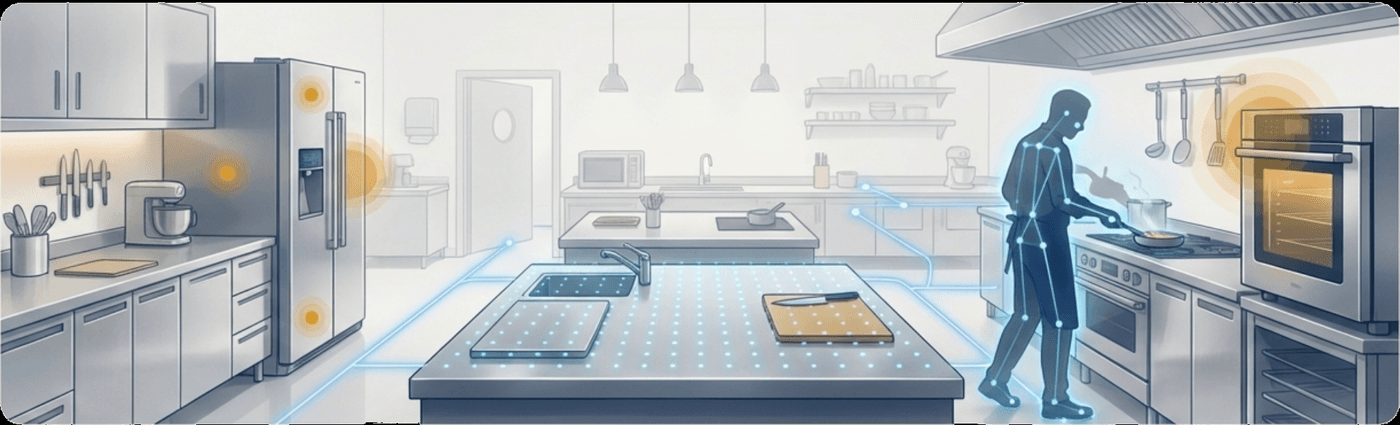
An annual hygiene rating is a snapshot, not a guarantee — a kitchen can pass on inspection day and drift out of compliance every day after, while a single foodborne-illness outbreak can cost an operator anywhere from a few thousand dollars to millions in fines and irreparable brand damage. The Smart Kitchen Safety OS replaces that periodic snapshot with persistent intelligence: a kitchen environment that is self-aware 24/7.
It begins by building a hyper-accurate 3D digital twin of the workspace from a simple video walkthrough — reconstructed with tools like DepthAnything, semantically segmented with SAM-3 to label critical zones (sink, fridge, raw-prep station), and confirmed with a one-time, user-assisted verification. That spatial model gives every downstream model true contextual awareness and lets the system localize exactly where each person is working.
On that foundation, computer vision continuously watches processes, people, and objects: lightweight detectors (YOLO-World class) flag unauthorized items, foreign objects, and missing PPE; a video-native action-recognition model verifies critical tasks such as a full 20-second handwash; and pose estimation tracks ergonomics and prompts rest breaks. Integrated IoT sensors make invisible data — cold-chain temperature, humidity, and staff wellness — visible and actionable.
Crucially, it is privacy-preserving by design. Video is analyzed on-device using skeletal tracking and anonymization; instead of streaming footage, the platform sends secure, encrypted metadata such as a confirmed handwash event — making it deployable even in sensitive home environments. It ships either as an edge device for privacy-first deployments or as scalable cloud GPU processing for large industrial operators, with all streams converging in one unified command center.
What it does.
Digital-twin foundation
A one-time video walkthrough builds a 3D spatial model (DepthAnything reconstruction, SAM-3 segmentation, user-verified) that gives every downstream model true contextual awareness and exact person localization.
Vision intelligence
Object detection for unauthorized items, foreign objects and PPE (masks/hairnets); action recognition that verifies a full 20-second handwash; cross-contamination, housekeeping, illumination, and ergonomic pose monitoring.
Integrated IoT senses
Wireless LoRaWAN/Bluetooth sensors automate cold-chain temperature logging and alert on fluctuations (e.g. fridge above 10°C for over an hour); biometric wearables flag fever or exhaustion early.
Privacy-preserving edge
On-device skeletal tracking and blurred visuals mean raw footage never leaves the kitchen — only encrypted metadata is sent, e.g. “Handwash complete: 25s at 10:32 AM.”
Flexible deployment
An edge device for privacy-first home and sensitive environments, or scalable NVIDIA-A40 cloud GPUs for large industrial operators at roughly $0.35/hour per stream.
Unified command center
Safety, cold-chain, supply-chain, and workforce data streams converge in one platform for complete operational oversight and a verifiable, real-time record of safety.
A multi-layered approach
The four layers that make a kitchen self-aware: a digital-twin foundation for contextual awareness, computer vision as the eyes, IoT sensors as the senses for otherwise-invisible data like temperature and humidity, and security and privacy as the underlying promise for deployment in sensitive environments.
Explore other projects.
Ergonomic Risk Platform
Markerless ergonomic assessment from a single ordinary camera.
View detailsAI PlatformsOrganizational Knowledge Brain
Not another database — a second brain for your organization that remembers, connects, and reasons.
View detailsHSESmart HSE Site Monitoring
Turn the cameras you already have into a 24/7 safety officer.
View detailsPrivacy & SecuritySensitive-Data Redactor
Find and redact sensitive data — while keeping records usable.
View detailsAI PlatformsConstruction Regulation Assistant
Context-aware technical consultation, grounded in the regulations.
View detailsAI PlatformsAutomotive After-Sales Intelligence
Four integrated AI modules that turn after-sales service into an accurate, self-improving system.
View detailsAI PlatformsIoT Smart-Metering Platform
Real-time monitoring and control over low-power, long-range networks.
View detailsTell us what you're building.
The first consultation is free. Use the assistant in the corner, or reach us directly.